 English
English
English

 English
English
English
English
English
In the highly automated industrial field, although standard guide rail bearings can meet most conventional needs, they become inadequate when facing extreme working conditions, special space limitations, or strict requirements for accuracy and lifespan. At this time, customized guide rail bearings have emerged. They are no longer simply standard parts procurement, but precision mechanical solutions that are deeply developed and designed according to users' specific application scenarios and performance goals.
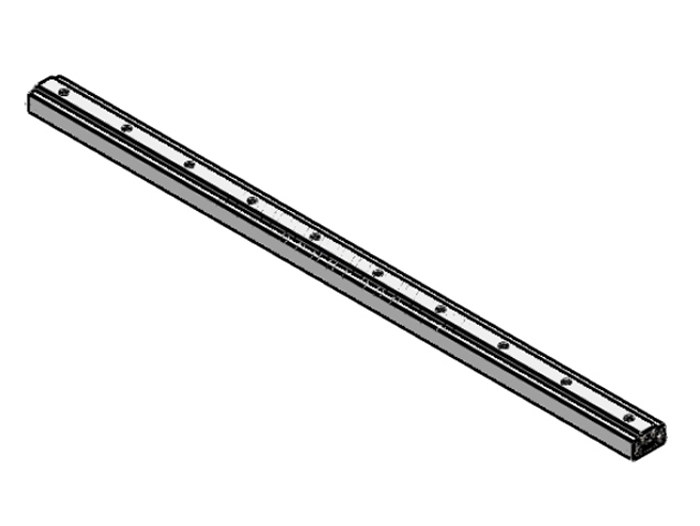
1、 Core concept: What is customization?
The essence of customized guide rail bearings is "tailor-made". It means comprehensive or partial targeted adjustments to the geometric structure, material formula, manufacturing process, and lubrication method of the bearing, to achieve perfect fit with the host equipment. Its goal is to achieve a balance between performance, lifespan, and cost under complex application constraints.
2、 The main dimensions and content of customization
1. Exclusive design for size and structure
Non standard dimensions: When the installation space of the equipment is limited or special load-bearing layout is required, the width, height, length of the guide rail section, as well as the installation hole spacing and shape of the slider, can be customized beyond the standard catalog range.
Shape variation of sliders: for example, customized flange, square, elongated or flat sliders to adapt to different installation methods and spatial structures.
Rolling track optimization: For specific load directions (such as mainly bearing lateral forces or overturning moments), the shape and angle of the rolling track can be optimized to maximize its rigidity and load-bearing capacity.
2. Accurate matching of materials and heat treatment
Steel upgrade: For highly corrosive environments such as food and medicine, chemical, and marine platforms, bearing rings and sliders can be made of martensitic stainless steel or austenitic stainless steel.
Special heat treatment: For high impact and heavy load conditions, deeper carburizing or nitriding treatment can be used to ensure that the raceway surface has extremely high hardness and wear resistance while maintaining good toughness in the core.
Ceramic components: In situations where high speed, low friction, electrical and magnetic insulation, or extreme high temperatures are required, ceramic (such as silicon nitride) balls can be used instead of traditional steel balls.
3. Personalized settings for precision and preloading
Accuracy level: Beyond standard accuracy, products with P2, P3, and even higher precision can be customized to meet the needs of ultra-high precision CNC machine tools, measuring instruments, and semiconductor equipment.
Pre compression level: Accurately adjust the pre compression amount (pre tension force) inside the slider according to the requirements for rigidity and smooth operation. Heavy duty and high rigidity applications require large preloading, while high-speed and low friction applications require light preloading or zero preloading.
4. Special adaptation for sealing and lubrication
Special sealing: In harsh working conditions with dust, chips, and water mist, multi lip contact sealing, labyrinth sealing, or special rubber material sealing systems can be configured to provide high-level protection.
Lubrication plan:
Pre filled lubricating grease: Customize and fill different types and amounts of high-performance lubricating grease according to the working temperature range (low or high temperature), speed, and load.
Integrated lubrication nozzle: Install the lubrication nozzle at the designated location for easy maintenance.
Central automatic lubrication system interface: designed for heavy-duty equipment that requires continuous operation, with an internal oil circuit that can be connected to the centralized lubrication system.
5. Integration and expansion of accessories and functions
Sensor integration: Integrating position, temperature, or vibration sensors inside the slider to achieve status monitoring and predictive maintenance of the guide rail system, meeting the needs of smart factories.
Special coating: Provides surface coatings such as black oxide, chrome plating, PTFE, etc. to enhance corrosion resistance, friction reduction, or appearance consistency.
3、 The Value and Applicable Fields of Customization
The core value of customized guide rail bearings lies in solving special problems. It is mainly suitable for:
Numerical Control Machine Tools and Machining Centers: Pursuing Accuracy and Dynamic Response.
Semiconductor and electronic manufacturing equipment: requires high cleanliness, high speed, and smoothness.
Medical and laboratory equipment: requires quietness, non-magnetic, and corrosion resistance.
Food packaging and beverage machinery: facing frequent washing and corrosive environments.
Heavy duty logistics and automated warehousing system: capable of withstanding huge loads and long-term uninterrupted operation.
Aerospace and military industries: responding to extreme temperature, high vacuum, and high reliability requirements.
Conclusion
Customized guide rail bearings represent the technological depth and user orientation in the field of precision mechanical transmission. It uses deep collaborative design and manufacturing to transform common components into "critical organs" specific to certain applications, thereby helping devices break through performance bottlenecks and establish core advantages in fierce market competition. Choosing customization is not just about choosing a product, but also about choosing an engineering partnership that safeguards success.


